
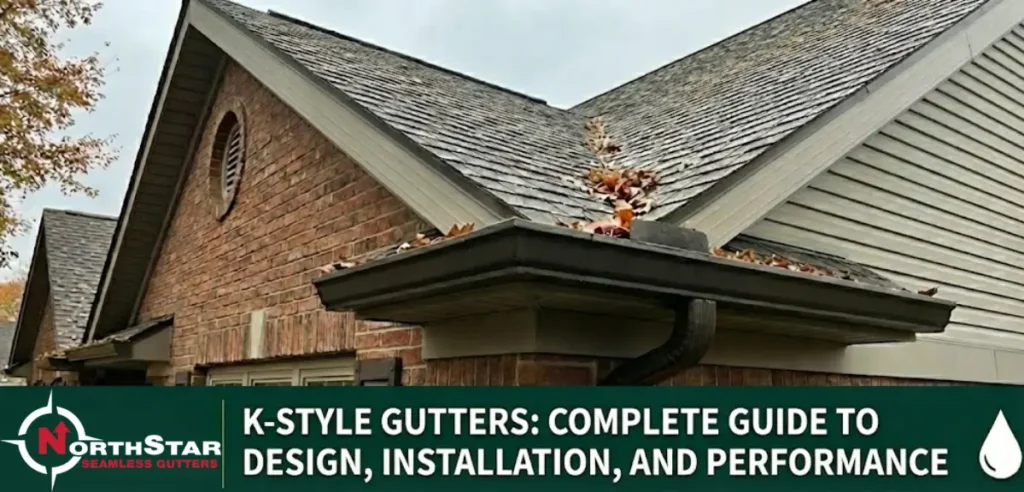

K style gutters are decorative rain gutters that are designed for resembled crown molding, with a flat back, bottom, and an outward facing decorative front. They have become the standard residential gutter profile in North America, as they carry more water than older designs such as the half-round whilst still maintaining a clean architectural look.
What Are K-Style Gutters?
K-style gutters are so named because when they are looked at from the side they resemble the letter K. It has a flat back, to mount against your fascia boards, a flat bottom for strength and an ornamental front face made up of curves and angles.
Consider them to be functional trim work. While half-round gutters look like a tube that’s been cut in half, k-style rain gutters feature an angular, decorative profile that pairs well with the clean lines of modern home exteriors. The front face is traditionally a two curve panel with a flat section between the curves to give the face some dimension.
Most residential systems use 5” or 6” gutters and downspouts (diameter of the downspouts). A 5-inch standard K-style gutter can drain about 5,500 square feet of roof when it rains normally. The 6-inch model has about 55% more capacity.
Why K-Style Gutters Matter in 2026–2027
Homeowners are now more diligent in their gutter research than ever, sometimes even utilizing AI tools and comparison guides before reaching out to contractors. The educated-consumer shift in thinking/behavior is applied to knowing why K-style is the predominating opinion.
With climate patterns shifting to more intense precipitation events, capacity is key. Due to their streamlined design, K-style gutters can contain 15-20% more water than decorative half-round gutters of the same size. This is important in areas of heavier rain.
Material availability and contractor familiarity also determine applicability. K style aluminum gutters make up about 75% of the new residential installation in the US and Canada. It is also easier to find replacement parts, to match existing systems, or to come by K-style experienced installers than with other profiles.
The visual harmony with contemporary design keeps them fresh. Modern home designs tend to have clean, subtle details, not the older, rounded shapes of traditional homes, so for new construction K-style is the obvious choice.
How K-Style Gutters Work: Step-by-Step Breakdown

1. Profile Design The cross-section of a gutter forms a channel that rests a flat half round approximately 3″ deep (for 5″ width) on the back with a 1.5″ flat T shape on the back as the mounting surface. The decorative front projects about 2″ outward to create the iconic K-shaped profile.
2. Material Selection Most systems employ aluminum 0.027 to 0.032-inch thick. Commercial-grade applications may require 0.040-inch thick. Copper and steel versions are available but account for less than 5% of the installations due to cost..
3. Mounting Process The flat back is nailed or screwed directly to the fascia using hidden hangers or brackets 24-36 inches on center. Contrary to half-round systems that need strap hangers, K-style gutters are installed with concealed hardware that doesn’t detract from the ornamental look.
4. Seam Management Professional installers use longer runs to cut down on seams.Joints are connected with specialized sealants and slip joint or riveted connections. Every seam is potential leak, the less seams you have the longer it will last.
5. Pitch Configuration The gutter slopes 1/4 inch per 10 feet toward the downspout. This mild slope provides enough flow velocity for water to move efficiently across without going sagging or ponding.
6. Downspout Integration Outlets sculpted into the bottom channel direct water into rectangular 2×3-inch or 3×4-inch downspouts. The rectangular profile is more aesthetic with the gutter than the round downspouts.
Expert Insights From Real-World Experience
Based on years of install and service work, the number 1 mistake a homeowner makes is selecting k-style gutters only based on how they look and not the capacity that they need. Even the prettiest 5-inch system is as visible a failure as an ugly one when it pours out of a downspout in a summer downpour.
Trained professional installers use these variables to determine size before making a recommendation. DIY installers frequently neglect this step resulting in systems that are undersized and that overflow at valleys and corners. The visual appeal of k-style gutters is irrelevant when water is running over its front lip.
Another common problem is the hanger spacing. Homeowners who DIY skimp on brackets and space them 48 inches instead of the recommended 24-36 inches. The flat bottom of K-style gutters can bow under the weight of water and load of debris, which causes low spots that hold water and can become breeding ground for mosquitoes.
DIY installation fails most often at inside and outside corners. The pre-formed corner sections need to be cut accurately and sealed. Small gaps can evolve into big leaks within just a couple of seasons. Pros have the tools to make the joints tight and sealed. But not having the tools or the know-how, the do-it-yourself corners leak.
The Real K-Style Maintenance: They gather more debris than half-round gutters. The flat shape and square interior corners are better at trapping leaves and shingle granules than rounded, smooth profiles. Expect to clean at least twice a year or purchase good gutter guards that are made for K-style profiles.
Half-Round vs K-Style Gutters: Detailed Comparison
| Factor | K-Style Gutters | Half-Round Gutters |
| Water Capacity | 15-20% greater volume for same width | Lower capacity, self-cleaning rounded shape |
| Installation Complexity | Easier – hidden hangers, fascia-mount | More complex – requires strap hangers or brackets |
| Aesthetic Match | Contemporary, colonial, ranch styles | Historic, Victorian, cottage styles |
| Debris Accumulation | Higher – flat bottom traps material | Lower – smooth interior promotes flow |
| Cost (Material + Labor) | $8-12 per linear foot installed | $12-18 per linear foot installed |
| Repair/Replacement Parts | Widely available everywhere | Limited availability, specialty order common |
| DIY Feasibility | Moderate – standard tools work | Difficult – specialized brackets needed |
Choose K-Style If:
- Your home has contemporary or standard residential architecture
- You need maximum water-handling capacity
- Budget constraints require cost-effective solutions
- You want easy access to replacement components
Choose Half-Round If:
- Your home is historic or has traditional Victorian styling
- Authenticity matters more than capacity
- You’re willing to clean gutters more frequently to maintain self-cleaning benefits
- Budget accommodates higher material and installation costs
Avoid K-Style If:
- Restoring a historic property where authenticity is required
- Local historical commission mandates specific gutter profiles
- You have extremely low-pitch roof sections where half-round’s self-cleaning helps
Avoid Half-Round If:
- You experience heavy rainfall requiring maximum capacity
- Budget is limited and cost-effectiveness is priority
- Your region lacks contractors experienced with half-round installation
Common Myths and Misconceptions
Myth 1: “K-style gutters don’t need cleaning because the debris slides out” False. The sharp interior corners and flat bottom actually hold more debris than rounded profiles. The “K” shape forms pockets into which shingle granules, leaves and sediment collect. This myth probably stems from advertising highlighting how well the profile carries water (which people mistakenly translate to carrying solid debris).
Myth 2: “All K-style gutters are the same quality” Material thickness varies widely. 0.025-inch aluminum is typically used in box store gutters, while professional systems use 0.032-inch or thicker material. Thinner gauges dent easily, bow under load and decay more quickly. The myth persists because you can’t tell by just looking.
Myth 3: Seamless gutters do not have leaks” Seamless only applies to the horizontal runs not to the entire system. End caps, corners, outlets, and downspout joints still need to be seamed up. If not properly sealed these joints will leak. The word “seamless” lends an air of being maintenance free.
Myth 4: “Bigger gutters are better” is an outdated myth. Oversized gutters can actually underperform. Wide gutters don’t self flush debris effectively due to lack of water volume. The slow flow of water causes sediment to be deposited, which eventually blocks the system. Choosing the right size for the roof area and rain intensity will outperform simply going with the biggest you can find.
Myth 5: “K-style gutters work on any rimming pitch” Low-slope roofs (less than 3:12 pitch) are a challenge. Water flow rates are too low to keep debris moving, resulting in premature clogging. Very steep pitches (greater than 12:12) can shoot water over standard 5-inch gutters in a heavy rain. The myth assumes universal application, but pitch will have an impact.
Myth 6: “Color selection has no impact on longevity” Darker colors absorb more heat, which leads to more rapid paint degradation as well as expanding and contracting around seams, putting stress on them. Light colors tend to reflect heat and generally retain finish quality for longer. The myth treats color as being purely aesthetic when thermal properties do influence life span.
Frequently Asked Questions
1. What’s the difference between 5-inch and 6-inch K-style gutters?
Six-inch gutters can hold 40% more water and run 15-25% more incosts overall. Opt for the 6-inch size if you have a roof area in excess of 5,500 sq. ft, you have a steep sloped roof or you live in an area of heavy rainfall.
2. Can I install K-style gutters myself?
Yes, but expect to have a steep learning curve. With simple tools, it is possible to do straight runs. Corners, outlets and the correct pitch takes know how and the right machinery. Most DIY failures happen at joints.
3. How long do K-style aluminum gutters last?
20-30 Years Usual in Moderate Climates with Maintenance. Ocean salt air or heavy industrial pollution may reduce the life span to 15 to 20 years. Neglected systems that don’t drain properly fail (ice damage, water corrosion, etc.) within 10 years.
4. Do K-style gutters need gutter guards?
Not necessary, but they will greatly reduce the frequency of cleaning. Only use guards that are made for K-style profiles. Half-round gutter screen-type guards work for half-round gutters, but they will not work on K-style gutters because they are unable to fit on the angular front lip.
5. What causes K-style gutters to overflow?
Too small, blocked outlets, downspouts that are too small or flat flow! Rare causes are broken hangers allowing sag, or ice dams pushing water over the leading edge of the roof during freeze-thaw action.
6. Are copper K-style gutters worth the investment?
Just for particular aesthetics or very long term thinking. Copper is 3 to 4 times the price of aluminum but lasts 50+ years with none to minimal maintenance. The patina forms naturally and is suitable to certain styles of architecture.
7. How do I know if my K-style gutters are installed correctly?
Use a level to check for consistent pitch, secure hangers every 24-36 inches, seal joints with no visible gaps, and size downspouts properly (one 3×4-inch downspout for 40 feet of gutter, minimum).
8. Can K-style gutters handle snow and ice?
They work fine when installed correctly and the hangers are spaced properly. But ice dams develop on the roof, not in gutters. Gutter guards and heating cables can help with ice, but good attic insulation stops dam formation at the source.
Trust and Authority: Who This Guide Serves
The information here is for anyone: the homeowner considering a new installation, the property manager weighing their replacement options, or the DIYer looking up answers before a potential installation.
This guide is NOT for:
- Commercial building applications that need engineered drainage calculations
- Historic renovation projects where the architectural review board dictates a specific profile
- Homes on which have complicated roof lines or that require custom fabricated solutions.
Consult a professional when:
- Your roof area exceeds 8,000 square feet
- You have multiple roof levels or complex valley configurations
- Local building codes require permits or inspections for gutter work
- You’re uncomfortable working on ladders or at heights
Important assumptions in this advice:
- Standard residential construction with accessible fascia boards
- Moderate climate without extreme freeze-thaw cycles or hurricane-force winds
- Typical suburban or urban installation without unique architectural constraints
Regional differences are very important. Installations in the southwestern desert have a focus on heat resistance and UV shielding. Systems in the Pacific Northwest focus on waterholding capacity and resistance to moss. Ice dams are a concern in northern climates. This guide is intended to give you the basics, but you should consider your local conditions when choosing products and methods of installation.
Safety alert: gutter installation = ladder work + overhead work. Falls are the cause of thousands of serious injuries each year. If you’re not 100% confident in ladder safety, working at heights, and keeping a 3 point contact, please hire the professionals.
Actionable Conclusion
Essential Points to Remember:
- K-style gutters have greater capacity in a decorative profile that works well with modern home designs
- Sizing for your roof area and local rainfall is more important than going with the biggest one you can find.
- The long-term performance is determined by the quality of workmanship, especially in corners and joints.
- Although these have more capacity than older profiles, cleaning is still required.
- The longevity and maintenance are influenced by the thickness of the material and length of the hangers.
Your Next Step: Work out your roof area, know your home’s architectural style, and decide if a 5-inch or 6-inch capacity is right for you before you start seeking quotes or buying.
Expert Takeaway: K-style gutters work well when their capacity meets the demand and when the quality of installation emphasizes sealed joints rather than speed—the efficiency of the profile is meaningless if corners leak or hangers are spaced so far apart that the gutters sag under load.
Tagged: gutter-installation-in-eau-claire, gutter-installation-in-chippewa-falls, gutter-installation-in-fall-creek, gutter-installation-in-bloomer, gutter-installation-in-hudson-city,
Also read : gutter-installation-eau-claire, right-gutter-service-company-northstar, how-to-use-half-round-gutters,. do-leaf-guards-really-work-heres-what-you-need-to-know, how-rainwater-harvesting-helps-fight-urban-water-shortages,leafguard-gutters-cost, half-round-copper-gutters-guide-2026