If you live in Wisconsin, your gutters must handle snow sitting for months, ice freezing inside the trough, sudden spring thaws, and constant freeze–thaw movement—not just rain. From our hands-on work across the state, we know this: most gutter failures here are caused by under-supporting and under-sizing systems for winter conditions. If a gutter system isn’t built for snow and ice first, it won’t last.
Everything below comes from real installs, repairs, and inspections we’ve done as the crew at NorthStar Seamless Gutter.
1. “My Gutters Keep Pulling Away From the House”
This is the most common problem we’re called out for, especially after winter.
What we usually find on-site
- Gutters fastened into soft or rotted fascia
- Hangers spaced too far apart
- Old spike-and-ferrule systems loosened by freeze–thaw cycles
On a home we worked on in north-central Wisconsin, the gutters looked fine all summer. After the first heavy snowfall, ice built up slowly, then pulled a 20-foot section loose during a thaw. The gutter didn’t fail—the fastening did.
What works in Wisconsin
- Hidden hangers screwed into solid wood
- Fascia inspected (and replaced if needed) before installation
- Extra support under valleys and long roof runs
Why this matters here: - Snow load doesn’t hit once. It builds, melts, refreezes, and shifts. Weak attachment points don’t survive that movement.
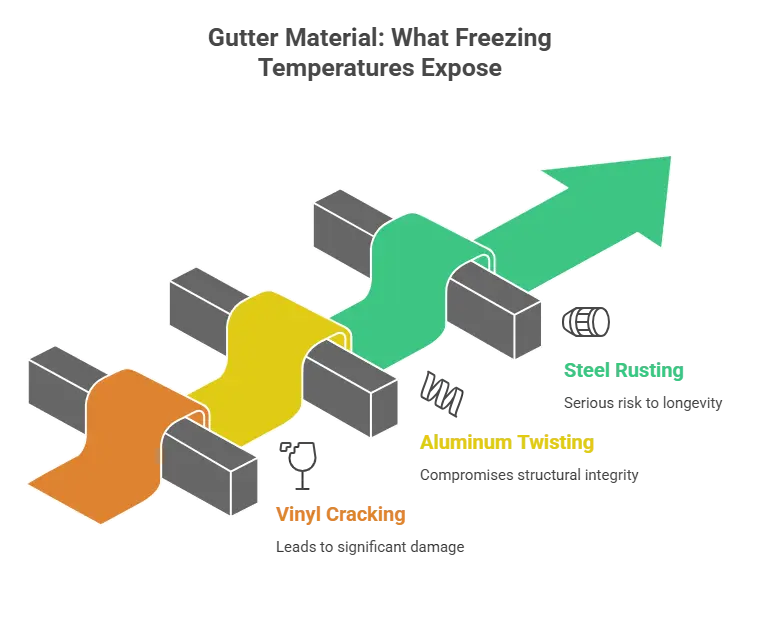
2. Gutter Material: What Freezing Temperatures Expose
What we’ve repeatedly seen fail
- Vinyl gutters cracking in extreme cold
- Thin aluminum twisting when ice forms inside
- Painted steel rusting once water sits and freezes repeatedly
We’ve replaced vinyl systems that shattered during cold snaps and aluminum gutters that warped after only a couple of winters.
What holds up better
- Heavier-gauge aluminum for most homes
- Steel gutters where snow slides hard or ice builds consistently
Why heavier material works:
When water freezes, it expands. Thin material flexes and stays bent. Thicker metal resists that expansion and returns to shape when temperatures rise.
3. “Why Do My Gutters Overflow Every Spring?”
Spring thaw is where Wisconsin gutters are truly tested.
What causes overflow here
- Gutters sized for rainfall, not snowmelt
- Long roof runs feeding too much water too fast
- Too few downspouts
We’ve watched perfectly clean 5-inch gutters overflow during March melt simply because the volume came too quickly.
What we’ve seen work better
- 6-inch gutters on steep roofs or long runs
- Additional downspouts to shorten water travel
- Proper pitch so meltwater doesn’t stall and refreeze
Wisconsin reality:
Spring melt isn’t gradual. Snow releases water fast during the day, then refreezes at night. Gutters need capacity and flow, not just cleanliness.
4. Pitch: The “Looks Nice” Choice That Causes Damage
Homeowners often ask for gutters to be installed perfectly level.
Why level gutters fail here
- Standing water freezes overnight
- Ice expands inside the gutter
- Hangers loosen and sections sag
What we install instead
- A subtle pitch—just enough to guide water smoothly in the correct direction
- Long runs split between multiple downspouts
Personal insight: - In our experience installing gutters across Wisconsin winters, poor pitch causes more long-term damage than ice dams themselves. Ice just finishes what trapped water starts.
5. Hanger Spacing: Why “Standard” Doesn’t Hold Up Here
National guidelines often call for 30-inch hanger spacing. In theory, that works.
In the Midwest, it doesn’t.
Snow load, freeze–thaw cycles, and shifting ice demand tighter support if gutters are going to last.
What we install instead
- 20-inch spacing as our standard installation
- 16-inch spacing in high-stress areas such as valleys and heavy snow-drop zones
This tighter spacing minimizes movement, reduces sag, and keeps the system locked in place through repeated winter cycles.
What we remove—constantly
- Low-grade, inexperienced hanger systems commonly sold at big-box stores
- Entry-level hangers supplied by local wholesalers that aren’t designed for sustained snow load
These systems may meet minimum specs, but they loosen, flex, and fail under real Midwestern conditions.
Our approach
We don’t install whatever is cheapest or most readily available.
We research, source, and partner with high-quality hanger manufacturers to build a gutter system we can stand behind—one engineered to withstand harsh Midwest weather, not just look good on install day.
Snow weight isn’t static. It shifts, melts, refreezes, and pulls.
A properly supported system accounts for that reality.
6. Why Drip Edge Matters in Wisconsin
Drip edge is a small detail with a big job. In Wisconsin’s climate, it plays a critical role in protecting both the roof edge and the gutter system.
Most homes already have drip edge installed. It’s a code requirement and is typically included during roof replacement. The issue isn’t whether it exists—it’s whether it’s doing its job correctly with the gutter system below it.
What drip edge does
- Directs meltwater cleanly into the gutter instead of allowing it to run behind the system
- Prevents water from backing up under shingles, especially during ice buildup and freeze–thaw cycles
- Protects the fascia board from repeated moisture exposure, rot, and deterioration
- Reduces ice-related damage by controlling how water leaves the roof edge
Why it matters specifically here
Wisconsin winters create constant melting and refreezing. Without proper water direction at the roof edge, moisture doesn’t just drip—it creeps. Over time, that leads to hidden damage behind otherwise intact gutters.
Drip edge creates a defined break between the roof and the fascia, ensuring water sheds forward into the gutter instead of soaking backward into the structure.
When installed and integrated correctly, it protects the roof edge, the fascia, and the gutter system as one complete assembly—not as separate parts.
7. Downspouts: The Part Everyone Underrates
Common mistakes we see
- One downspout serving too long a run
- Water dumped right next to the foundation
- Frozen underground drains with no slope
What works better here
- One downspout every 30–35 feet
- Extensions pushing water at least 3 feet away
- Above-ground drainage where freezing is unavoidable
We’ve seen basement seepage disappear simply by correcting downspout discharge.
8. Gutter Guards: The Honest Version
No gutter guard is maintenance-free in Wisconsin.
What fails
- Cheap mesh collapsing under ice
- Guards lifting when ice dams form
What sometimes works
- Rigid metal surface-tension systems
- Only when pitch, hanger spacing, and fascia are correct
If ice dams are severe, guards can trap ice and make removal harder.
What You Can Do Right Now
Walk around your house and check:
- Are any gutter sections sagging?
- Do you see standing water after rain?
- Are hangers spaced closer than two feet?
- Is the fascia solid behind the gutter?
- Do downspouts move water well away from the house?
If any of these look off, winter will make it worse.
conclusion
Wisconsin winters don’t care how your gutters look in July. If they’re not built for snow load, ice expansion, and fast spring melt, they’ll fail—and sometimes take fascia or roofing with them. We’ve seen simple systems last decades and expensive ones fail quickly. The difference was always how they were installed for winter, not how they were marketed.
FAQs We Hear From Wisconsin Homeowners
1. Do gutters really need to be built differently here?
Yes. Freeze–thaw cycles punish weak installs.
2. Are seamless gutters better for Wisconsin?
Fewer joints means fewer points of failure and fewer leaks.
3. Why do my gutters overflow even when they’re clean?
Usually undersized gutters or not enough downspouts.
4. Can ice dams destroy gutters?
Yes—we’ve replaced entire systems after one bad winter.
5. Is DIY gutter installation realistic here?
Possible, but mistakes show up fast in this climate.
6. How often should gutters be inspected?
Every fall and after spring thaw.
7. Should gutters ever be removed for winter?
No. Properly installed systems are designed to stay.
Tagged: gutter-installation-in-eau-claire, gutter-installation-in-chippewa-falls, gutter-installation-in-fall-creek, gutter-installation-in-bloomer, gutter-installation-in-hudson-city,
Also read : gutter-installation-eau-claire, right-gutter-service-company-northstar, how-to-use-half-round-gutters,. do-leaf-guards-really-work-heres-what-you-need-to-know, how-rainwater-harvesting-helps-fight-urban-water-shortages,leafguard-gutters-cost, half-round-copper-gutters-guide-2026, k-style-gutters-complete-guide, downspout-installation-complete-guide, snow-guards-for-metal-roofs